Posted: December 3, 2023 • Posted in: Action, Discussions, Peace
The Israel-Hamas war: Where is the hope?
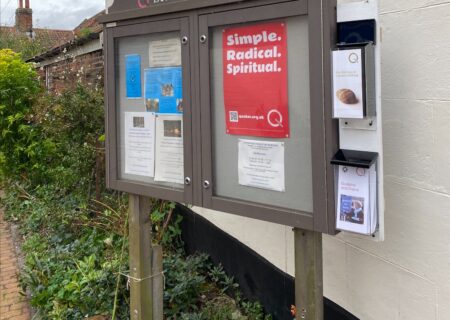
On Friday 10 November Quakers held a Peace Vigil in Beccles. We were joined by others, whilst some of us engaged with passers-by who wanted to learn more. Afterwards we held a discussion asking ‘Where is the hope?’ This is how the subject was introduced and reflects a personal view that set the scene. (We have updated the statistics below to the date of this article, 30 November.)
Where is the hope?
The Hamas attacks on Israel on 7 October killed 1,200 people with around 240 others taken hostage. Since then, Gaza’s Hamas-run health ministry says more than 14,800 people have been killed in Israel’s retaliatory campaign, including about 6,000 children. (BBC 30 November 2023)
Hatred and deep mistrust along with anger and a desire for revenge on both sides makes the situation appear hopeless.
Without hope though there is just despair. It’s easier to turn away and do nothing. But is this really an option? What do we hope for? That the war will stop, justice will prevail, and reconciliation will be possible?
Our peace testimony
Our peace testimony provides a starting point. It is one of opposition to war and support for peace and peace building. This is not a creed or a set of rules but, along with other Quaker testimonies, a signpost to a way of living, an expression of how we should live in this world. It leads us to bear witness to a different way – a way that affirms the value of all life rather than to deny it through warfare.
We are all likely to have a different take on the testimony, given life experience, our understanding of a situation, and our preconceptions and prejudices. Each new conflict requires us to reassess our response to the testimony trying to see all sides of the conflict and decide where our peace testimony should lead us.
Our response
It seems to me there are two phases to our response that will be more or less appropriate at different stages of the conflict.
Initially we have to be concerned with pressing humanitarian issues. For example, lobbying for ceasefire, vigils, and protests, humanitarian aid (Medical Aid for Palestinians for example), and prayer.
Then, when it is possible, we have a role supporting peace building. To me this is where hope lies.
In the context of Israel and Palestine, peacebuilding is something we’ve rarely focused on as a Meeting, being largely concerned with the injustice of the plight of the Palestinians in the West Bank, Lebanon and Gaza.
There are many groups in the Middle East and internationally that are working for peace and deserve our support. We need to explore these further and understand their approach and what we might contribute. A long-lasting peace is dependent not only on elected decision makers but also on ordinary people who in their everyday practices carry out justice and peace on the ground recognizing our common humanity. Surely this is where hope lies.
Pulling it together
In all the reporting of the horror occasionally a voice of reason emerges which can offer hope and which to me is like balm to the soul. There are 2 short statements that I have come across that I have found helpful in thinking in a positive way about my witness.
The first is from a well-known Israeli author Yuval Noah Harari, an excerpt from a longer article published in Time magazine 16 October.
He begins by saying that people on both sides of the war are so full of pain they are incapable at this time of empathizing with the suffering of the others on the other side. He goes on to say:
Outsiders who are not themselves immersed in pain should make an effort to empathize with all suffering humans, rather than lazily seeing only part of the terrible reality. It is the job of outsiders to help maintain a space for peace. We deposit this peaceful space with you, because we cannot hold it right now. Take good care of it for us, so that one day, when the pain begins to heal, both Israelis and Palestinians might inhabit that space.
A role for us – holding the space for peace.
The second is an extract from a letter from Tom Ling sent to his local MP.
Tom quotes an extract from Seamus Heaney’s poem ‘The Cure at Troy’. This was relevant to in the quest for hope of a resolution to the “troubles” in Northern Ireland and is equally applicable here.
So hope for a great sea-change
on the far side of revenge.
Believe that a further shore
is reachable from here.
Believe in miracles
and cures and healing wells.
Tom goes on to say:
We need our leaders to embrace this even-handed hope, ‘the far side of revenge’. This involves more than feeble statements that both sides should operate within international law. It involves some bravery and, yes, leadership. Reaching that further shore would indeed be a miracle but it is reachable and will only happen if our leaders articulate what this shore looks like and how we might get there.
Another line in Seamus Heaney’s poem says:
But then, once in a lifetime
the longed-for tidal wave
of justice can rise up,
and hope and history rhyme.
Tom concludes:
Let us be part of that tidal wave of justice.
Steve (Beccles Quaker Meeting)
Related Posts